Product Description
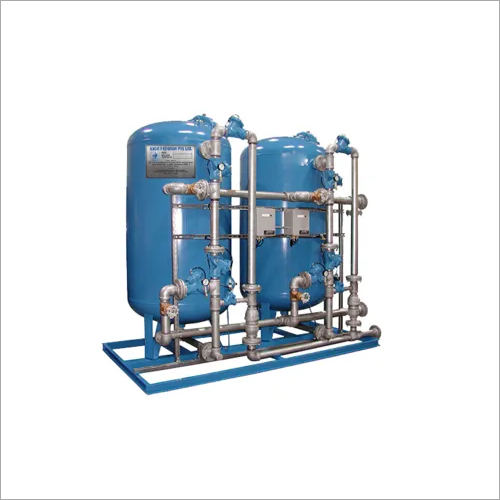
Water Softening Plant:-
Water softening plant is used for removal of total hardnessdissolved in water. Water softening plant ensures the maximum utilization ofthe effective surface area, uniform space and linear velocity across the resinbed which provides effective contact time between water and resin bed yieldsoft water and prevent any precipitation and scale formation on the surface ofheat exchanges and any process equipment where water is being used for furtherapplication.
Why softening is done?
- Scale build-up in pipes, resulting in decreased flow rates
- Scale build-up on heating and cooling systems, leading toincreased electricity costs and break downs.
- White film on glass surfaces and staining on Water taps.
- Increased laundry costs due to hard Water reacting with soap andlaundry detergents.
- A softener controls scaling by removing hard scale formingcation such as calcium and magnesium and exchanging (i.e., replacing) theseions for non scale- forming sodium ions.
Working principle
Water softening is a process where Calcium and Magnesium ionsare exchanged for Sodium ions. Calcium and Magnesiu mions associated withAlkalinity contribute for scale formation. These ions are also called as Totalhardness.
The process of ion exchange softening is completed using resinbeads coated in sodium as a medium.
The sodium of the resins attracts the ions of the minerals thatharden the water.
As the hard water flows through the mineral tank, the sodiumions, which line the sides of the tank, are replaced by the mineral ions thatare in the water flow, thus removing those hard water minerals from the water,producing softened water.
When the resin is exhausted, it is regenerated with brinesolution(Sodium Chloride) 10 % or 15% brine solution is normally used for there generation.
Our Water Softening Plant is known for its low maintenance,strong construction and easy to install features. It is widely used indifferent sectors like dairies, pharmaceuticals, chemicals industries,hospitals and many more places
This compact self contained system comprises SS vessels, UPVC piping and many more components. Moreover, our highly effective Water SofteningPlant is based on ion exchange process to convert hard water ions of magnesiumto sodium ions.
It effectively removes all the hardness salts and provides avaluable return on your investment.
Water softener plant is designed to remove calcium and magnesiumions which cause the hardness of water.
The hardness in raw water gets exchanged with sodium ions in thesodium based cationic resin bed, thus giving real soft water
Water softening plant is available in Manual as well as PLC based controlsystem with Fully Automatic Option. It is available in FRP/MSRL models.Water softener plant is designed to cater to the requirement of scalePrevention of Utility / Plumbing Fixtures from Total Hardness.
softeners are available for Bungalow Institutional/ Industrialapplications.
Water Softening Plants have been peculiarly designed to maketreated water that is suited for various applications.
Treated water of this plant is of consistency quality & havereduced residual hardness throughout the service cycle. The plants are employedto remove excessive levels of dissolved calcium & magnesium.
Also, these are used for the separation of total hardness aswell as soluble iron dissolved in water
Product details
|
Cleaning System
|
UV
|
|
Usage/Application
|
Commercial
|
|
Material
|
SS
|
|
Certification
|
ISO
|
|
I deal in
|
New Only
|
|
Automation Grade
|
Automatic
|
Advanced Ion Exchange TechnologyOur plant employs robust cation exchange resin to remove hardness ions efficiently from various water sourcesborewell, underground, or municipal. The ion exchange process replaces calcium and magnesium ions with sodium, yielding soft, quality water suitable for industrial, commercial, or domestic applications.
Tailored to Your RequirementsWith customizable capacities (1 m/hr 100 m/hr), dimensions, colors, and construction materials, this system adapts to your specific site and process demands. Optional pre-filtration and accessories like pressure gauges ensure optimal performance and operational ease.
Reliability & Ease of MaintenanceBuilt for durability, this plant offers an 8-10 year service life, owing to its corrosion-resistant materials and robust design. Automatic, semi-automatic, or manual operation modes and user-friendly controls facilitate easy installation and simple, scheduled maintenance.
FAQs of Water Softening Plant:
Q: How does the water softening plant remove hardness from water?
A: The plant uses strong acid cation exchange resin to replace hardness ions like calcium and magnesium with sodium ions through the ion exchange process, resulting in significantly softer water.
Q: What is the regeneration process for the resin, and how often is it required?
A: Regeneration involves flushing the resin with a salt (NaCl) brine solution to restore its ion exchange ability. The frequency depends on water hardness and daily usage, typically ranging from every few days to weekly for industrial use.
Q: Where can this water softening plant be installed?
A: It is designed for floor mounting in industrial, commercial, or domestic settings, and can be placed wherever softened water is requiredsuch as factories, offices, hospitals, or homes.
Q: What are the benefits of using this plant for water treatment?
A: The main benefits include effective removal of water hardness, improved water quality, extended equipment service life, reduced maintenance, corrosion resistance, and flexibility in operation modes and system capacity.
Q: Can the system handle highly hard water, and what is the maximum limit?
A: Yes, it tolerates inlet water hardness up to 1000 ppm as CaCO3. Water leaving the system will have hardness less than 5 ppm, making it suitable for various high-demand applications.
Q: What options are available for capacity and system construction?
A: Capacities range from 1 m/hr to 100 m/hr with customizable tank sizes from 200 to 1000 liters. Construction materials include Mild Steel, FRP, or Stainless Steel, chosen based on the application and customer preference.
Q: What maintenance is necessary, and what is the expected service life?
A: Routine maintenance mainly involves periodic resin regeneration using a salt solution and basic checks of system components. With proper upkeep, the plants service life spans 8-10 years.

 English
 Spanish
 French
 German
 Italian
 Chinese (Simplified)
 Japanese
 Korean
 Arabic
 Portuguese


 Send Inquiry



 Send Inquiry
 Send SMS
